Bunjazi Central Forest Reserve, Ssese Islands | Uganda
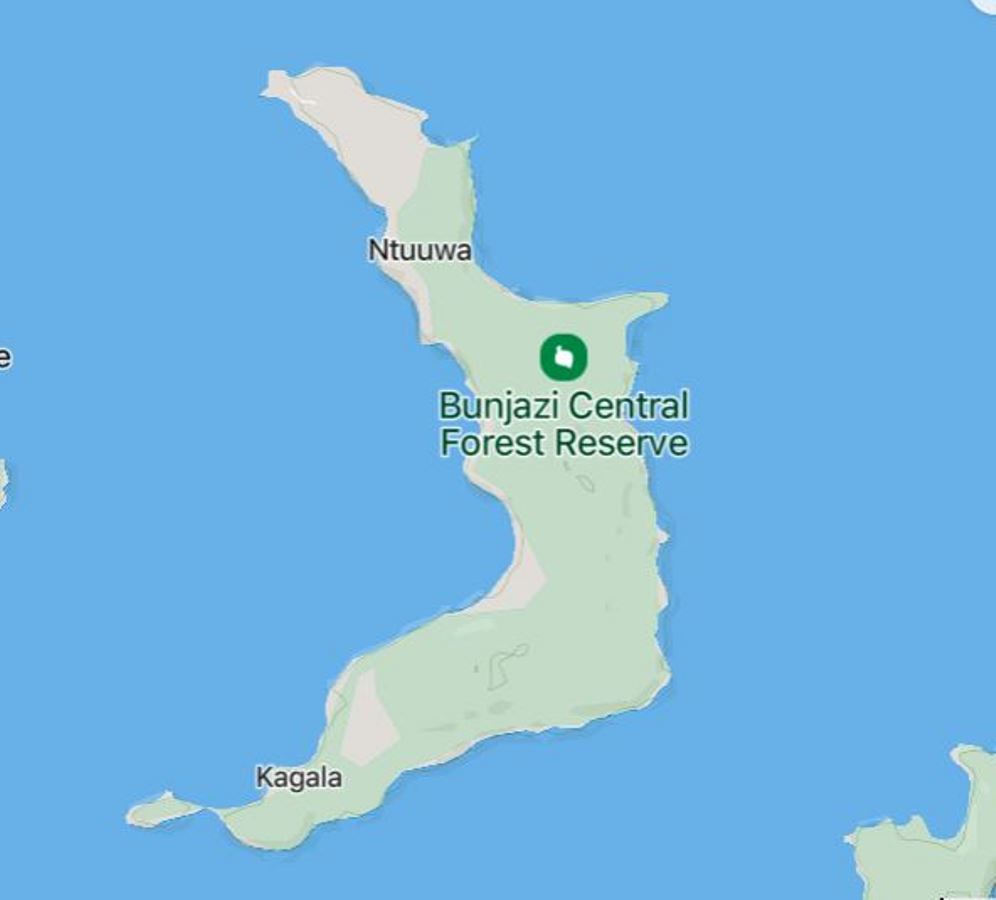
The Bunjazi Central Forest Reserve is located on the Ssese Islands in Uganda, specifically in the Kalangala District. These islands are situated in the northwestern part of Lake Victoria.
The reserve is characterized as a medium-altitude moist forest, forming a belt along the lake and the lower ridges with a gentle slope from the lakeshore to the center.
Bunjazi Central Forest Reserve covers an area of 80 hectares.
Bunjazi Central Forest Reserve Location
The Bunjazi Central Forest Reserve is situated in the Kalangala District of Uganda, specifically within the Ssese Islands archipelago, a group of 84 islands located in the northwestern part of Lake Victoria.
The Ssese Islands are approximately 60 kilometers southwest of Entebbe, across the waters of Lake Victoria, making them accessible primarily by ferry or boat from the mainland.
The Bunjazi Central Forest Reserve is positioned on one of these islands, contributing to the region’s rich ecological and biodiversity profile.
Geographically, the reserve is characterized as a medium-altitude moist forest, with an elevation typically ranging between 1,100 and 1,200 meters above sea level.
Bunjazi Central Forest Reserve forms a forested belt along the lakeshore of Lake Victoria, extending along the lower ridges of the island with a gentle slope from the shoreline toward the interior.
This topography creates a unique microclimate conducive to the growth of dense, evergreen forest vegetation. The reserve spans an area of approximately 80 hectares, making it a relatively small but ecologically significant protected area within the Ssese Islands.
The Ssese Islands, including Bunjazi, are part of Uganda’s Central Region and are known for their lush, tropical environment, which supports a variety of flora and fauna.
The Bunjazi Central Forest Reserve is one of several forest reserves in the Kalangala District, which collectively play a critical role in conserving the region’s biodiversity, including rare plant species, birds, and primates such as the vervet monkey and the black-and-white colobus.
The forest’s proximity to Lake Victoria also influences its ecosystem, with the lake’s humid conditions fostering a moist forest environment that contrasts with the drier savanna landscapes found elsewhere in Uganda.
Administratively, the reserve falls under the management of the National Forestry Authority (NFA) of Uganda, which oversees its conservation and sustainable use.
The surrounding Ssese Islands are home to local communities that rely on fishing, agriculture, and tourism for their livelihoods, with the forest reserve serving as an important ecological and cultural asset. The islands are also a growing tourist destination, with attractions such as beaches, cultural sites, and other forest reserves complementing the ecological significance of Bunjazi.
Access to the Bunjazi Central Forest Reserve typically involves traveling to the Ssese Islands via ferry from Bukakata or Nakiwogo on the mainland, with Kalangala Town serving as the main hub on the islands. From there, local transportation or guided tours can provide access to the reserve.
The forest reserve’s location on the Ssese Islands makes it somewhat remote, preserving its natural state but also posing challenges for conservation efforts due to pressures from human activities such as agriculture and settlement expansion.
Bunjazi Central Forest Reserve History
The Bunjazi Central Forest Reserve, located on the Ssese Islands in the Kalangala District of Uganda, is a medium-altitude moist forest spanning approximately 80 hectares.
Situated in the northwestern part of Lake Victoria, it forms part of a unique ecological and cultural landscape within the Ssese archipelago.
This report explores the historical context of the Bunjazi Central Forest Reserve, tracing its origins, colonial influences, post-independence developments, conservation efforts, and contemporary significance.
While specific historical records on Bunjazi itself are limited, this report draws on broader historical patterns of Uganda’s forest reserves, particularly those managed by the National Forestry Authority (NFA), and integrates available information specific to the Ssese Islands and Bunjazi.
Pre-Colonial Period (Pre-1894)
Before European colonization, the Ssese Islands, including the area encompassing Bunjazi, were part of the Buganda Kingdom, a powerful centralized state in what is now central Uganda.
The islands held cultural and spiritual significance for the Baganda people, with forests like Bunjazi serving as natural habitats for diverse flora and fauna, including rare primates, birds, and butterflies.
The forests were likely used by local communities for resources such as timber, medicinal plants, and food, as well as for spiritual practices, given the islands’ association with traditional Buganda religious sites.
The Bunjazi forest, described as a medium-altitude moist forest, formed a belt along the lakeshore, with a gentle slope from Lake Victoria to the island’s interior, supporting a rich ecosystem.
During this period, the Ssese Islands were relatively isolated due to their location in Lake Victoria, which preserved their forests from extensive exploitation.
The Buganda Kingdom practiced sustainable resource use, with forests managed communally under customary land tenure systems.
There is little evidence of significant deforestation or large-scale agricultural encroachment in Bunjazi before colonial intervention, as the islands’ economy was primarily based on fishing and subsistence agriculture.
Colonial Era (1894–1962)
The establishment of British colonial rule in Uganda in 1894 marked a significant shift in land and forest management, including in the Ssese Islands.
The 1900 Uganda Agreement between the British and the Buganda Kingdom formalized land tenure systems, categorizing much of the land, including forests, as either Crown Land or under Buganda’s control through the mailo system.
Forests like Bunjazi were likely classified as Crown Land, bringing them under colonial administration. The British recognized the ecological importance of Uganda’s forests for timber production and environmental services, such as water regulation, prompting the establishment of forest reserves.
By the early 20th century, the colonial government began formalizing forest management. In 1929, a policy was introduced to reserve forests for sustainable timber production and environmental protection, leading to the designation of Central Forest Reserves (CFRs) like Bunjazi under the central government’s authority.
Smaller forests were designated as Local Forest Reserves (LFRs) managed by local governments. Bunjazi, with its modest 80-hectare area, was likely designated as a Central Forest Reserves (CFRs) due to its ecological value and strategic location along Lake Victoria.
The colonial administration prioritized forests for their economic potential, with timber harvesting becoming a regulated activity. However, the Ssese Islands’ isolation limited large-scale logging in Bunjazi compared to mainland forests like Budongo or Mabira.
The colonial period also saw the introduction of new agricultural practices and crops, which began to exert pressure on forested areas.
On the Ssese Islands, the expansion of agriculture and settlement slightly impacted forests like Bunjazi, though their remoteness offered some protection.
Additionally, the islands attracted explorers, such as Henry Morton Stanley, who reportedly camped near Lutoboka (a neighboring forest reserve) during his expeditions to the “Mountains of the Moon.”
While Stanley’s activities did not directly affect Bunjazi, they highlight the historical significance of the Ssese Islands as a point of interest during colonial exploration.
Post-Independence and Political Upheaval (1962–1986)
Uganda gained independence in 1962, and the management of forest reserves, including Bunjazi, continued under the newly formed central government.
The 1961 “New Buganda Agreement” transferred much of the Crown Land, including forests, to the Buganda Kingdom, except for those deemed nationally significant, such as Central Forest Reserves (CFRs).
Bunjazi remained a Central Forest Reserve, managed by the central government’s forestry department. However, the post-independence period was marked by political instability, particularly during the 1970s and 1980s, under regimes such as Idi Amin’s (1971–1979) and subsequent civil wars.
During this period, law and order broke down, and forest reserves across Uganda faced significant threats.
While mainland forests like Budongo experienced poaching, illegal logging, and chimpanzee smuggling, the Ssese Islands’ isolation likely shielded Bunjazi from the worst of these impacts.
Nonetheless, local communities on the islands may have increased resource extraction from Bunjazi for timber, fuelwood, and agricultural land due to economic hardship and lack of enforcement.
The forest’s biodiversity, including its populations of rare monkeys, birds, and butterflies, likely faced pressure, though specific records of Bunjazi’s status during this time are scarce.
Establishment of the National Forestry Authority (1986–Present)
The end of Uganda’s civil conflicts in 1986, with the rise of the National Resistance Movement under President Yoweri Museveni, ushered in a new era of forest conservation.
In the late 1980s, the government instituted a policy to dedicate half of Uganda’s forest reserves to sustainable timber production and the other half to environmental protection, with 20% designated as nature reserves.
This policy laid the groundwork for the establishment of the National Forestry Authority (NFA) in 2004 under the National Forestry and Tree Planting Act of 2003. The National Forestry Authority (NFA) was tasked with managing all 506 Central Forest Reserves, including Bunjazi, to ensure sustainable use and conservation.
Bunjazi, as a smaller Central Forest Reserve, was prioritized for environmental protection due to its ecological significance as a habitat for rare and endemic species.
The forest’s medium-altitude moist environment supports a variety of primates, such as vervet and colobus monkeys, as well as numerous bird and butterfly species.
The National Forestry Authority’s management focused on maintaining the forest’s integrity, developing eco-tourism, and engaging local communities in conservation efforts.
The Ssese Islands, including Bunjazi, were recognized for their tourism potential, with activities such as forest walks, bird watching, and primate identification promoted to visitors.
Conservation Challenges and Efforts
Despite its protected status, Bunjazi Central Forest Reserve faces ongoing challenges. The Ssese Islands have experienced population growth and increased agricultural activity, particularly palm oil plantations, which have led to deforestation pressures in the region.
While Bunjazi’s small size and island location offer some protection, encroachment for timber, fuelwood, and land remains a concern.
The National Forestry Authority (NFA) has implemented measures to combat illegal activities, such as patrolling and community engagement programs, but enforcement is challenging due to limited resources and the islands’ remoteness.
Eco-tourism has emerged as a key strategy for Bunjazi’s conservation. The forest’s trails, developed for non-strenuous walks, allow visitors to explore its biodiversity while generating revenue for conservation.
The National Forestry Authority (NFA), in collaboration with local communities and private developers, has promoted Bunjazi alongside other Ssese Island reserves like Lutoboka and Kampala as eco-tourism destinations.
Activities such as bird watching, primate identification, and butterfly spotting attract nature enthusiasts, while nearby beaches and cultural sites enhance the islands’ appeal. Accommodation options, ranging from lodges to budget guesthouses in Kalangala Town, support tourism development.
Research on Uganda’s forest reserves, including those on the Ssese Islands, has highlighted their ecological importance.
A 1991 study by the International Union for Conservation of Nature (IUCN) emphasized the biodiversity of Uganda’s tropical forests, and while Bunjazi was not specifically mentioned, its characteristics align with the moist forests studied.
The forest’s role in water regulation, given its proximity to Lake Victoria, and its support for endemic species make it a critical conservation site.
Partnerships with organizations like the International Union for Conservation of Nature (IUCN) and local Non-Government Organisations have supported reforestation and habitat restoration efforts in similar reserves, which may benefit Bunjazi in the future.
Contemporary Significance
Today, Bunjazi Central Forest Reserve remains a vital component of Uganda’s conservation landscape. Its 80-hectare area, though small compared to larger reserves like Budongo (82,530 hectares) or Mabira (30,600 hectares), is significant for its unique island ecosystem.
The forest contributes to the Ssese Islands’ reputation as a biodiversity hotspot and eco-tourism destination. Its medium-altitude moist forest supports a delicate balance of species, and its conservation is crucial for maintaining the ecological health of the Lake Victoria region.
The National Forest Authority continues to manage Bunjazi under a framework that balances conservation with sustainable use.
Community involvement is critical, as local residents participate in eco-tourism and conservation activities, reducing dependence on forest resources.
However, challenges such as climate change, invasive species, and potential land-use conflicts persist, necessitating ongoing vigilance and investment in conservation.
The history of Bunjazi Central Forest Reserve reflects broader trends in Uganda’s forest management, from pre-colonial communal use to colonial formalization, post-independence challenges, and modern conservation efforts.
As a small but ecologically significant reserve on the Ssese Islands, Bunjazi has been shaped by its isolation, cultural importance, and biodiversity.
The establishment of the National Forest Authority (NFA) and the focus on eco-tourism have bolstered its protection, but challenges remain. Continued efforts to engage local communities, promote sustainable tourism, and address environmental threats will be essential to preserving Bunjazi’s natural and cultural heritage for future generations.
Bunjazi Central Forest Reserve Map