
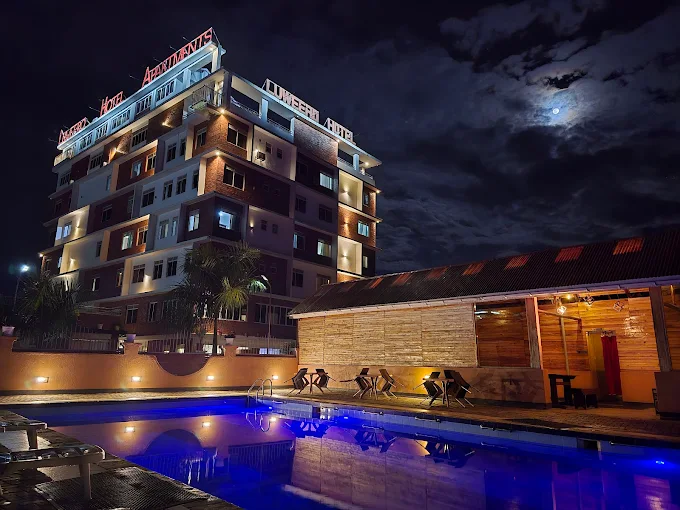
Luweero, Uganda
Location of Luweero Town, Uganda
Luweero Town is located in the Central Region of Uganda and serves as the main municipal, administrative, and commercial center of Luweero District.
The town is situated approximately 62 kilometers (39 miles) north of Kampala, Uganda’s capital city, along the highway to Masindi. This road is a busy, all-weather tarmac highway, making Luweero easily accessible.
Geographical Coordinates of Luweero Town, Uganda
Luweero town is positioned at 0°49'59.0"N, 32°29'58.0"E (Latitude: 0.833056; Longitude: 32.499444). The town sits at an elevation of approximately 1,100 meters (3,600 feet) above sea level.
Luweero District is bordered by:
Mukono and Wakiso Districts to the south,
Nakaseke District to the west,
Nakasongola District to the north,
Kayunga District to the east.
Population of Luweero Town, Uganda
As of 2025, the population of Luweero Town is estimated to be 616,242 by the UBOS.
History of Luweero Town, Uganda
Luweero town, located in the Central Region of Uganda, has a rich and complex history, particularly due to its role in Uganda’s political and military struggles.
Before Uganda gained independence in 1962, Luweero was a relatively small settlement within the former East Mengo District, with its administrative headquarters in Bombo. In 1974, East Mengo was divided into Mukono District and Luweero District, marking the beginning of Luweero’s distinct administrative identity.
The Luweero Triangle and Ugandan Civil War (1981–1986)
Luweero is most famously known for its role in the Ugandan Bush War, fought between 1981 and 1986. The town was part of the Luweero Triangle, a region that became the epicenter of the guerrilla war between the Uganda National Liberation Army (UNLA) and the National Resistance Army (NRA), led by Yoweri Museveni. The war devastated the area, leading to widespread destruction, loss of life, and displacement of civilians.
During this period, Milton Obote’s soldiers conducted brutal raids in Luweero, targeting villages suspected of supporting the National Resistance Army (NRA) rebels. The conflict left deep scars on the town, with mass graves and memorial sites serving as reminders of the war’s impact.
Post-War Reconstruction and Growth of Luweero Town, Uganda
After the National Resistance Army’s (NRA) victory in 1986, Luweero began a slow process of recovery. The Ugandan government initiated reconstruction programs, focusing on infrastructure, education, and healthcare. The town gradually regained its economic and administrative significance, becoming a key commercial hub in the region.
Today, Luweero Town is a thriving municipality with a growing population and improved infrastructure. It remains an important historical site, with landmarks such as the Butuntumula War Memorial, which commemorates those who lost their lives during the war.
| Visa requirements | ENTRY INTO UGANDA (VISAS & PASSES)
Any person intending to enter into Uganda should do so only for lawful purposes and in accordance with national immigration laws, guidelines and formalities.
Foreign nationals intending to enter Uganda for purposes of employment should comply with requirements for expatriate employment in Uganda.
All visa prone nationalities must obtain Uganda visas to facilitate their entry into the country.
Uganda visas may be obtained at Uganda missions abroad or by applying online at the Uganda E-Immigration System at www.visas.immigration.go.ug
UGANDA VISAS & CORRESPONDING FEES:
WORKING AND LIVING IN UGANDAPERMITS –WORKING IN UGANDA All foreign nationals intending to work in Uganda must ensure that they are in possession of the relevant work permit. The classes of work permits are listed below. For the requirements for the different categories, please log onto the Immigration Uganda website: www.immigration.go.ug or www.visas.immigration.go.ug CLASS A (GOVERNMENT & DIPLOMATIC SERVICE) Applicants should be persons contracted for service in the Government of Uganda or diplomats accredited for service in Uganda. CLASS A2 (GOVERNMENT CONTRACTORS) Applicants should be persons on Government contracts, including persons serving in Government tertiary institutions. CLASS B (INVESTMENT IN AGRICULTURE) Applicants should be persons intending to invest in the business of agriculture or animal husbandry. CLASS C (MINING) Applicants should be persons intending to invest in the business of prospecting for minerals or mining in Uganda CLASS D (BUSINESS AND TRADE) Applicants should be persons intending to carry on the business or trade in Uganda CLASS E (MANUFACTURERS) Applicants should be persons intending to engage in manufacturing business In Uganda CLASS F (PROFESSIONALS) Applicants should be members of prescribed professionals Intending to practice RIO profession In Uganda CLASS G1 (VOLUNTEERS, NGO WORKERS, and MISSIONARIES) CLASS G2 (EMPLOYEES) Applicants should be persons intending to work as employees whether for gain or not in Uganda. Applicants under this category can only enter Uganda after grant and payment for their work permits. WORK PERMIT RENEWAL
| ||||||||||||||||||||||||
|---|---|---|---|---|---|---|---|---|---|---|---|---|---|---|---|---|---|---|---|---|---|---|---|---|---|
| Languages spoken | Luganda, English, Swahili, Runyoro, Kinubi | ||||||||||||||||||||||||
| Currency used | Ugandan Shilling (Ugx) | ||||||||||||||||||||||||
| Area (km2) | 2,217.6 square kilometers | ||||||||||||||||||||||||
| Country name | Republic of Uganda |